

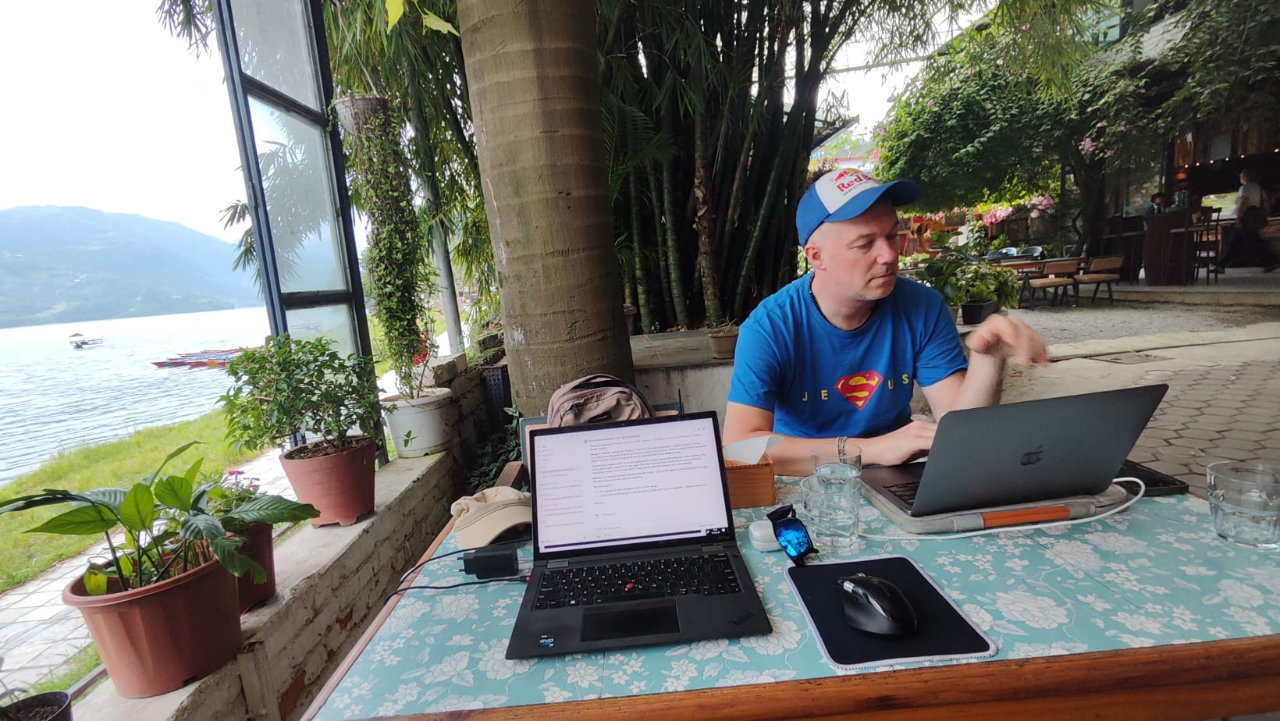
Traveling while running a business has taught me that freedom needs structure.
You still need to serve your clients, generate revenue, and follow through on your commitments. The difference is that you have more control over where and how you do those things.
For me, the goal is to build a business that supports a life I enjoy, with enough consistency to keep it sustainable. Here’s what I recommend for making that work, especially as a founder with ADHD.
1. Decide What You Want Your Days to Look Like
Before choosing a business model, think about your actual week.
How many hours do you want to work? How many calls can you comfortably handle? Do you want mornings free for hiking and meditation, or afternoons free to explore?
Those decisions should shape your offers, your pricing, and the customers you serve.
If your business requires you to be available eight hours a day in someone else’s time zone, that will influence where you can live comfortably. If you want to lead retreats several times a year, your other commitments need to leave room for them.
Design an ordinary Tuesday you would enjoy. Then build a business that can support it.
For ADHD founders, this is especially important. A business can look exciting on paper but become exhausting when every day is filled with context switching, unpredictable demands, and decisions you have to make from scratch.
2. Align Passion, Purpose, and Profit
Working for yourself requires motivation. Working for yourself while traveling requires motivation when there’s a mountain outside your window and someone inviting you on an adventure.
That’s why I keep coming back to three questions:
- Passion: What work keeps me curious and engaged?
- Purpose: Who do I want to help, and why does it matter to me?
- Profit: What problem will people pay me to solve?
You need all three.
Passion without demand can become an expensive hobby. Profit without interest can leave you avoiding your own business. Purpose without a sustainable income makes it difficult to keep contributing.
Look for the overlap, then test it with paying customers before building something elaborate.
ADHD can make new ideas feel especially compelling. Use that energy to explore possibilities, but let customer demand and your actual capacity determine what becomes a business.
3. Make One Offer Reliable Before Adding More
I love new ideas. That doesn’t mean every idea needs its own website by Friday.
For a founder with ADHD, there’s a real temptation to respond to every burst of excitement by starting something new. But each new offer creates more marketing, delivery, administration, and decisions.
My recommendation is to establish one clear source of revenue first.
Choose a specific customer, a meaningful problem, and an offer with a clear outcome. Get that working consistently before expanding.
You can keep a list of future ideas. Writing something down gives you a place to return to it without letting it take over your current priorities.
A simple rule can help: capture new ideas immediately, but review them only at a scheduled time. That way, you don’t have to suppress your creativity, and you don’t have to let every idea interrupt your current work.
4. Productize Your Expertise
A location-independent business becomes easier to manage when every client engagement doesn’t require reinventing your process.
For coaches and consultants, that means turning your expertise into a repeatable offer with defined boundaries.
Be clear about:
- The outcome you help people achieve.
- What the offer includes.
- How long the engagement lasts.
- When clients can access you.
- What requires an additional fee.
Then create reusable resources for the parts you explain repeatedly: templates, exercises, recorded lessons, onboarding materials, and checklists.
You can still provide personal attention. Having a consistent process gives you more energy for the parts that genuinely require your judgment.
Over time, this can also create a foundation for group coaching, workshops, courses, or a membership.
Clear boundaries are particularly useful when you have ADHD. They reduce the number of decisions you need to make, make it easier to estimate your workload, and help prevent an enthusiastic yes from becoming an unsustainable commitment.
5. Travel Slowly Enough to Build a Routine
My preference is usually to spend at least three months in a location.
That gives me time to find a comfortable workspace, build friendships, learn my way around, and settle into a rhythm. It also means I spend fewer working days dealing with transport and accommodation logistics.
A travel day rarely costs only the hours you spend in transit. There’s packing, planning, settling in, and recovering your attention afterward.
When choosing somewhere to stay, I’d look closely at:
- Reliable internet and a backup connection.
- A quiet place for focused work and calls.
- Comfortable sleeping conditions.
- Easy access to food, exercise, and nature.
- A time zone that fits your commitments.
- A community you actually want to participate in.
A beautiful apartment becomes less appealing when every client call features a surprise motorcycle orchestra.
ADHD often makes transitions more disruptive than they appear on a calendar. Give yourself time to settle before expecting peak productivity. Keep a familiar morning routine, use the same work setup where possible, and avoid scheduling important deadlines immediately after a move.
6. Give Your Workweek a Few Anchors
You don’t need to schedule every minute. You do need to know when the important work will happen.
I recommend a simple weekly rhythm:
| Anchor | What it’s for |
|---|---|
| Weekly planning | Choose the few outcomes that matter most |
| Protected focus blocks | Create, solve problems, and finish important work |
| Call windows | Group client calls and meetings into predictable periods |
| Sales and follow-up time | Keep future revenue moving |
| Weekly review | Check progress, finances, and next steps |
Choose a realistic workload. Leave space for ordinary life and the occasional logistical headache.
For ADHD founders, it can help to make the next action very concrete. “Work on marketing” leaves a lot to interpret. “Write and send the workshop invitation” gives you somewhere to begin.
Use visible reminders, timers, checklists, and calendar blocks to reduce the amount you have to hold in your head. Your system should make it easier to start, not simply record what you failed to finish.
7. Keep Customer Acquisition Simple and Consistent
You want a business that keeps finding customers while you’re living your life.
That requires a repeatable way for people to discover you, understand your offer, and take the next step.
Start with one primary acquisition channel that fits your strengths and your market. That might be search content, workshops, partnerships, referrals, or direct outreach.
Then connect it to a clear path: an email signup, an inquiry form, a booking page, or a purchase.
Keep following up. Keep communicating with your audience. Keep asking satisfied clients for referrals.
Avoid disappearing from your marketing every time you travel. A modest routine you maintain is more useful than an ambitious strategy you repeatedly abandon.
For ADHD founders, consistency does not have to mean doing the same task every day. It can mean creating a small menu of repeatable actions: publish one useful piece of content, contact two potential partners, follow up with three leads, or ask one client for a referral.
8. Build Systems Around Things You Forget or Avoid
Pay attention to the tasks that repeatedly slip through the cracks.
If you forget follow-ups, put them in a system with reminders. If onboarding feels chaotic, create a checklist. If you answer the same questions repeatedly, build a useful resource clients can access.
Good places to start include:
- Appointment scheduling and reminders.
- Invoices and payment collection.
- Client onboarding.
- Lead tracking and follow-ups.
- Recurring task reminders.
- Document storage and backups.
AI can help draft, summarize, organize, and prepare work for review. Give it a defined job and check the output before it reaches a client.
Build systems to solve problems you already have. Otherwise, setting up productivity software can become a very sophisticated way to avoid doing your work.
The best system is usually the one you will actually use when you are tired, distracted, or in a new place. Keep it visible, simple, and connected to the tools you already open.
9. Make Community Part of the Plan
Community is one of the biggest factors in whether this lifestyle feels nourishing or draining.
I look for places with conscious communities, entrepreneurs, and creative people. Through Social Creators, I also bring people together through retreats and creator houses.
Sharing a villa with friends can create a rhythm of working, eating, exploring, and learning together. Those relationships have much more room to develop than they do during a brief stop somewhere.
You don’t have to host a retreat to do this.
Join a recurring coworking session. Attend the same weekly event. Invite a few people on a hike. Return to places where you already have friends.
Build around repeated contact. Familiar faces make a place feel like home.
Community can also provide external structure, which is valuable when internal motivation is inconsistent. A regular coworking session or accountability call can make it easier to begin work and follow through.
10. Use Lower Living Costs to Create Breathing Room
One of the opportunities of location independence is choosing places where your income goes further.
But compare the full cost of living, including accommodation, transport, coworking, insurance, and travel between destinations. Frequent flights and short stays can eat through the savings quickly.
Know what it costs to cover your personal life and run your business. Build a buffer for quieter months and unexpected expenses.
Then decide what you want lower costs to give you.
It might be fewer working hours, more time to develop an offer, or the ability to choose clients more carefully. You don’t have to turn every financial advantage into another reason to work more.
For ADHD founders, financial breathing room can also reduce the pressure to chase every opportunity. A buffer gives you more space to choose work that fits your strengths and your preferred way of living.
11. Keep the Practical Foundations Organized
Location independence still comes with practical responsibilities.
Before moving somewhere, check the entry and work permissions relevant to your situation, your insurance coverage, and any tax or business obligations with qualified help where needed.
Keep important documents accessible and secure. Use strong account security, maintain backups, and have a plan if your laptop or internet connection fails.
Set clear expectations with clients about your availability and response times.
These foundations protect the flexibility you’re trying to create.
Create one central place for essential information: travel documents, insurance details, emergency contacts, client procedures, account recovery information, and backup instructions. The goal is not to build a perfect administrative system. It is to make important information easy to find when your attention is already under pressure.
12. Adjust the Lifestyle When It Stops Working
You don’t have to prove you can travel indefinitely.
If you feel scattered, stay longer. If you feel isolated, prioritize community. If the time zone is ruining your sleep, reconsider the location.
A home base for half the year and travel for the other half can be a great arrangement. So can returning to the same few places, where you already know the people and the routines.
For me, the value of being a digital nomad is having the freedom to choose environments that support my energy, relationships, and work.
I want a business that gives me room to spend time in nature, explore different cultures, bring people together, and contribute through projects like Sacred Treks.
The question I keep returning to is simple: Does the way I’m building this business support the life I want to live?
For ADHD founders, I’d add another question: Does the way I’m running this business support how I actually function?
A business that looks flexible but depends on constant self-discipline, endless context switching, and unpredictable availability may not create the freedom you want.
Build around your real attention, energy, and needs. Use structure to protect your freedom, not to restrict it.
That’s a question worth asking before booking the next flight, and before saying yes to the next opportunity.

For the past decade, I've been coaching ADHD entrepreneurs to build businesses that work with their brains and create more freedom in their lives.
I also run an AI search marketing agency for leading health and travel brands. My latest venture, Sacred Treks, offers sacred mountain pilgrimages in some of the world's best ecotourism destinations.
- Why I Became a Digital Nomad As A Founder With ADHD - September 16, 2026
- How to Build a Business You Can Run From Anywhere With ADHD - September 15, 2026
- Flow State Psychology: 16 Flow Triggers For Better ADHD Focus - September 15, 2026


